

Artificial intelligence is rapidly becoming embedded in how projects are run. Recently, 78% of organizations globally reported using AI – up from just 55% the year before[1] – and in the project management domain nearly 97% of project and portfolio management (PPM) professionals say they are experimenting with AI tools[2]. Yet adoption has outpaced preparedness. Fewer than half of PPM professionals (46%) trust AI to operate without human oversight[2], revealing a gap between enthusiasm and readiness.
The 2026 PPM Priorities Report by Smartsheet underscores this paradox: project leaders feel intense pressure to “do AI” even as they grapple with trust deficits, governance gaps, and fragmented toolsets that limit measurable outcomes[2][3]. This article examines the state of AI adoption in project management through that report’s findings, augmented by global research, to explore the challenges and strategic path from AI experimentation to enterprise impact.
Organizational AI Readiness Gaps
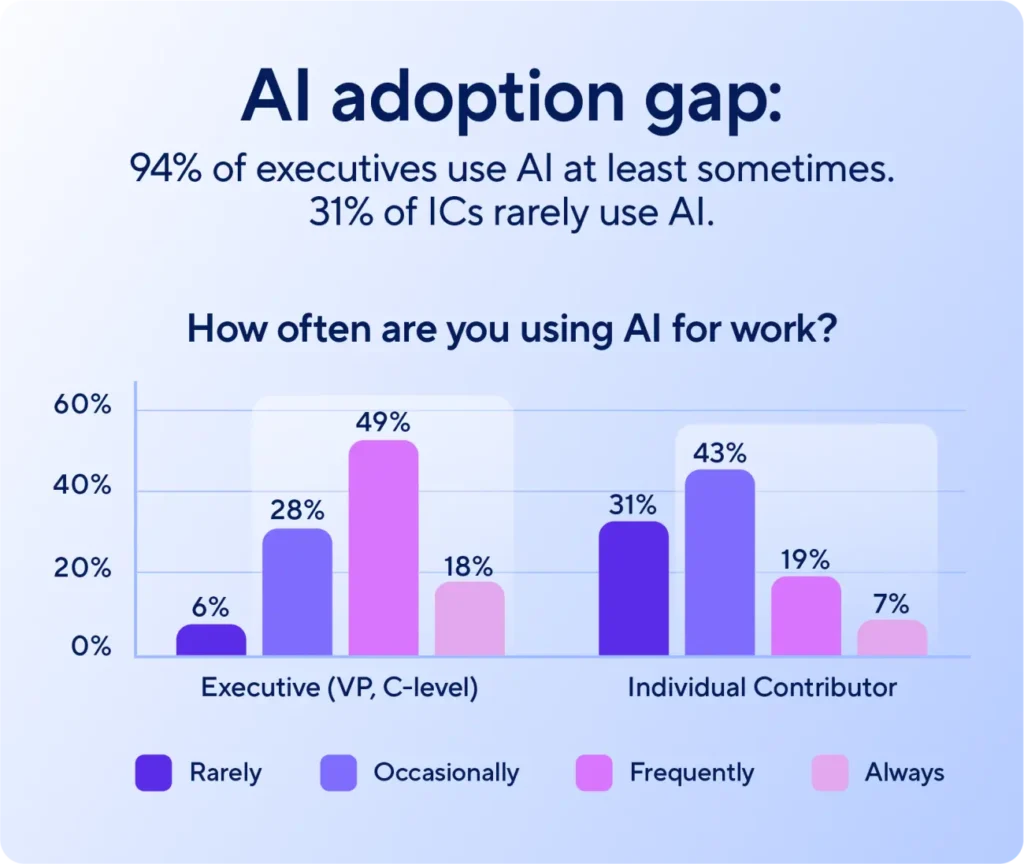
Despite skyrocketing interest, many organizations lack the foundations to harness AI effectively. Governance and oversight are often playing catch-up with adoption. Just 36% of companies have established an AI governance policy (standalone or integrated), meaning most have no formal rules to ensure ethical, secure AI use[4]. In practice, this translates to limited guidance on data privacy, risk management, or accountability for AI-driven decisions. Likewise, leadership and strategy are struggling to keep pace. A 2025 McKinsey report found that while 92% of companies plan to increase AI investments in the next three years, only 1% of business leaders feel their company’s AI use is “mature” – i.e. fully integrated into workflows with meaningful outcomes[5]. This points to a leadership gap: employees are often eager and ready to embrace AI, but many leaders have not yet provided the vision, training, and integration needed to unlock AI’s full potential[6][7].



Another readiness gap lies in skills and enablement. Organizations may deploy AI tools, but without sufficient training and change management, those tools sit underutilized. Many project professionals report struggling to acquire the technical knowledge to use AI effectively, with 49% citing lack of training as a key challenge in adopting AI on projects[8]. In fact, project talent is now expected to upskill: one study noted 66% of corporate leaders would not hire someone without AI skills, and 71% would prefer a less-experienced candidate who has such skills over a more experienced one without them[9]. This signals an urgent need for workforce development so that AI readiness – not just AI availability – becomes a core organizational competency.
Fragmented Tools and Workflow Silos
Early AI adoption in project management has often been piecemeal, leading to fragmentation in tools and workflows. Many teams experiment with multiple AI apps – from scheduling assistants to risk analysis bots – in isolation. A recent survey found that over 1 in 4 enterprises now use 10 or more different AI applications, yet 70% of enterprises haven’t moved beyond basic integration of these tools[10][11]. In other words, most AI tools operate in silos with minimal connection to each other or to core project systems. The Smartsheet 2026 report similarly notes that when AI capabilities exist separately from unified work management systems, organizations end up multiplying silos instead of eliminating them[12][13]. The result is an “AI sprawl” that limits visibility and impact.
The consequences of tool fragmentation are tangible. Project leaders struggle to demonstrate measurable outcomes from AI initiatives. Despite widespread AI use, only 39% of PPM professionals say their current tools make it easy to show contributions to project results[14]. Similarly, 61% report difficulty proving AI’s impact on outcomes with the tools they have[15]. This makes it hard to justify AI investments or scale pilots into enterprise-wide solutions. Moreover, disjointed tools force workarounds: 22% of enterprises end up manually transferring data between siloed AI systems, and 29% say these manual patches are eating up employees’ time – paradoxically adding workload that AI was meant to remove[16][17]. Nearly 3 in 4 enterprises (76%) have experienced negative outcomes due to disconnected AI, from wasted spending on redundant software to heightened security and privacy risks as shadow AI tools proliferate outside of IT’s purview[18]. Clearly, integrating AI into cohesive workflows is not just an IT issue but a strategic imperative to realize value. Forward-looking organizations are starting to respond: 90% of enterprise leaders now say having a central AI orchestration platform is important for success[19] – yet only a third have begun investing in one[20]. The message is that unifying platforms, data, and processes is critical to convert AI activity into business impact.
Workforce Attitudes: Optimism vs. Anxiety
Among project professionals, attitudes toward AI are marked by a mix of excitement and unease – often simultaneously. On one hand, optimism about AI’s benefits has surged. In the UK, for example, those believing AI will have a “very positive” impact on their industry jumped from 15% in 2023 to 62% by 2025[21]. Many practitioners see AI as a powerful enabler to automate low-value tasks and improve decision-making. In Smartsheet’s global survey, 87% of PPM pros viewed AI as an opportunity to transform how they work, focusing their time on higher-value strategic activities[22]. And surveys show project teams already noticing advantages: high adopters of generative AI report gains in productivity, creativity, and problem-solving skills, with PMI research finding “GenAI trailblazers” significantly outperform low adopters in areas like data analysis, planning and risk management[23][24].
On the other hand, anxiety is palpable. The fear of job displacement looms large even as people embrace AI. Smartsheet found 74% of project portfolio professionals worry their role could be replaced by AI within five years[25]. This aligns with broader workforce trends – McKinsey notes that while a slight majority of employees are AI optimists, a full 41% remain apprehensive, concerned about where this rapid change leaves them[26]. It’s a genuine paradox: project professionals are using AI more than ever (82% say they use it more frequently than they anticipated a few years ago[27]) and recognize its value, yet many harbor personal uncertainty about their long-term relevance. This optimism-versus-fear dichotomy often plays out as initial enthusiasm for AI pilot projects, followed by hesitation to fully automate or trust AI with critical decisions. Indeed, about half of employees worry about AI’s accuracy and security risks[28], reflecting the trust gap that must be overcome to move from experimental use to confident reliance.
Crucially, the anxiety is not so much a rejection of AI as a call for support and reskilling. Project professionals want to evolve with the technology. They are eager to gain AI skills (many are proactively learning prompting, data analytics, etc.) and they expect their organizations to help. Encouragingly, 70% of project managers in one survey felt their employers are adequately preparing them for AI’s rise (and the remaining are in progress on upskilling)[29]. Business leaders are starting to acknowledge this mandate: in addition to hiring for AI skills, companies are investing in training programs to turn anxiety into confidence. As the CEO of APM observed, “This isn’t about replacing project managers, but about enabling them – freeing up time, enhancing analysis, and improving decision-making.”[30] In other words, the future project workforce will be defined not by competition between humans and AI, but by collaboration – if organizations can navigate the transition with empathy, clarity, and solid strategy.
From Experimentation to Enterprise Impact: Strategic Way Forward
To convert today’s AI experimentation into sustained enterprise impact, project organizations and PMOs should take a strategic, value-driven approach. The following actions can help bridge the gap between AI optimism and operational reality:
- Establish Strong AI Governance: Treat AI as a business capability that requires policies and oversight just like finance or cybersecurity. Develop clear AI governance frameworks (ethics guidelines, data privacy rules, quality control checkpoints) to build trust in AI systems. Given that less than half of companies have any AI policy today[4], putting governance structures in place is an urgent first step for responsible scaling. This includes setting guidelines on acceptable AI use cases, addressing bias, and ensuring human accountability for AI-generated outputs.
- Integrate and Unify Tools: Curb the fragmentation by embedding AI into core project management workflows and platforms, rather than using a myriad of stand-alone apps. Integration is key – consolidate tools where possible and connect AI outputs (e.g. risk predictions, scheduling suggestions) directly into project dashboards and data streams. By uniting people, data, and AI in one ecosystem, organizations gain end-to-end visibility. For example, adopting an “Intelligent Work Management” approach – as highlighted in the Smartsheet report – can orchestrate work across teams with enterprise-grade governance and cross-system data flow[31][32]. The goal is to eliminate silos so that AI enhancements translate into real, measurable improvements in delivery and outcomes.
- Invest in Skills and Change Management: Upskilling the project workforce is non-negotiable. Implement training programs to raise AI fluency among project managers and team members – from basic AI concepts to advanced tool use and prompt engineering. Encourage certifications or hands-on workshops to ensure people feel confident with new AI-driven processes. Pair this with change management initiatives that clearly communicate the role of AI as augmenting, not replacing, human expertise. When employees understand that AI can take over routine tasks (and only with oversight), they are more likely to embrace it. Leverage early adopters or “AI champions” within teams to mentor others, creating a culture of continuous learning. Remember that technology adoption is as much about people as tech; as the data shows, closing the “AI confidence gap” depends on user-friendly tools and adequate support for users at all levels[33].
- Focus on High-Value Use Cases and Outcomes: Rather than deploying AI for AI’s sake, be strategic in choosing applications that align with business priorities. Identify project management pain points or inefficiencies where AI can add real value – for instance, automated project status reporting, predictive resource allocation, or intelligent risk flagging. Start with pilot projects in these areas, but define success metrics (e.g. reduction in reporting time, improved on-time delivery rates) from the outset. Tracking and publicizing these wins is vital to build confidence among stakeholders. Over time, scale up what works and iterate or halt what doesn’t. By tying AI initiatives to clear outcomes and ROI – and reporting those to executives – PMOs can move the narrative from hype to proven impact[34]. This also helps counter skepticism by demonstrating that AI is contributing to strategic goals (like faster project delivery or cost savings), not just generating flashy demos.
- Lead with a Human-Centric Vision: Finally, leadership must proactively shape an AI-augmented vision for the project organization. This means articulating how AI will elevate the role of project professionals – freeing them from drudgery to focus on strategic leadership, stakeholder management, and creative problem-solving. By openly addressing both the opportunities and the anxieties, leaders can foster a mindset that welcomes innovation while valuing human judgment. Practical steps include establishing cross-functional AI task forces or centers of excellence to oversee implementation, and involving end-users in design and testing of AI solutions. When project teams feel they have a voice in how AI is adopted, their buy-in and trust increase. Strong executive sponsorship is also critical: companies that leap ahead on AI maturity often have leaders who set bold goals and model an agile, learning-oriented culture[6][28]. In short, project leaders should champion AI as a strategic priority – with the message that those who harness AI effectively will improve project outcomes and increase their professional value, not render themselves obsolete.
Conclusion:
AI’s surge into project management is a story of both great promise and urgent growing pains. We see extraordinary adoption rates and optimism about smarter ways of working, coupled with clear shortfalls in readiness, integration, and skills. This paradox – high AI uptake but low trust – is a natural phase in any disruptive innovation. The challenge now for project organizations worldwide is to close the gap through deliberate strategy: invest in the “boring” foundations of governance and training, break down tool silos, and realign processes so that human expertise and AI systems amplify each other. Those that succeed will move beyond scattered AI experiments to enterprise-level impact, converting automation into strategic advantage and freeing their people to deliver greater value. In the end, the future of project management will not be man or machine, but man and machine – a symbiosis achieved by preparedness, not chance. With bold yet thoughtful leadership, PMOs can navigate from AI hype to a new era of intelligent work management, where project professionals thrive alongside their digital teammates[22][35] and projects deliver results at a scale and speed previously unimaginable.

Sources: The insights and data in this article are drawn from the Smartsheet 2026 Project & Portfolio Management Priorities Report[2][3] and corroborated by international research including PMI[9], the World Economic Forum[36], APM[37][8], McKinsey[5][26], and others as cited above. These sources highlight a common narrative: AI adoption is racing ahead of organizational readiness, but with the right strategic focus, project leaders can turn today’s AI paradox into tomorrow’s project success story.
[1] The 2025 AI Index Report | Stanford HAI
https://hai.stanford.edu/ai-index/2025-ai-index-report
[2] [3] [12] [13] [14] [15] [22] [25] [31] [32] [33] [34] [35] The era of Intelligent Work Management | Smartsheet
[4] AI adoption is soaring, but few companies are measuring its impact | S&P Global
[5] [6] [7] [26] [28] AI in the workplace: A report for 2025 | McKinsey
[8] [21] [27] [29] [30] [37] AI use in Project Management nearly doubles in just two years, APM survey finds
[9] pmi.org
[10] [11] [16] [17] [18] [19] [20] Tool sprawl limits AI integration for 70% of enterprises
https://zapier.com/blog/ai-sprawl-survey
[23] [24] Genai Adoption Research
https://www.pmi.org/about/press-media/2024/genai-adoption-research
[36] The Future of Jobs Report 2023 | World Economic Forum
https://www.weforum.org/publications/the-future-of-jobs-report-2023/digest